Your distributor's IRR is 39%. Yours is 9%
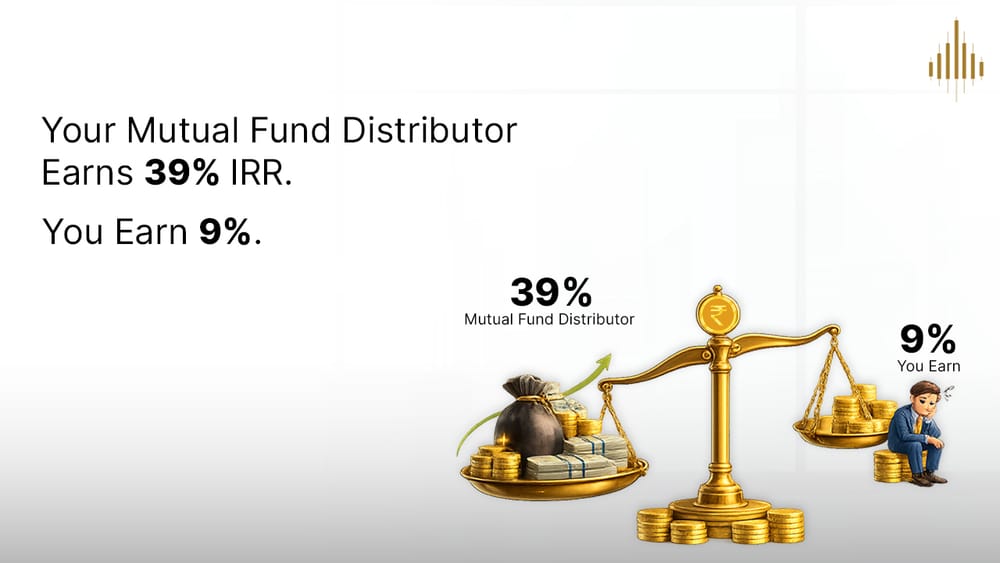
Your mutual fund distributor earned a 39% IRR over the last decade. You earned 9%, even though both of you invested in the same fund over the same period. Here's how. You invest ₹100 in a fund returning 10% annually. The distributor takes a 1% commission on your AUM, so your net return is 9%. He reinvests his commission into the same fund as a direct plan, paying no commission to anyone. He gets the full 10%.
Assume he also put in ₹1 of his own alongside your ₹100. After 10 years, your ₹100 has become ₹237. His ₹1 has become ₹27. That 1% sounds small on a yearly basis, but there’s a reason compounding is called the eighth wonder of the world. It adds up.
You might think this is worth it if the distributor picks great funds. The data says otherwise. According to the data from S&P, which computes major indexes worldwide, including the Sensex in India, 73% of Indian large-cap funds and 82% of mid/small-cap mutual funds underperformed their S&P benchmarks over 10 years. Over 5 years, 90% of large-cap funds failed to beat the index. You're paying 1% a year for fund selection that, seven or eight times out of ten, would have been beaten by a simple index fund.
Now, many distributors do genuine work. Research, portfolio construction, handholding through volatile markets. That's worth paying for. The problem is when the compensation model creates conflicts. Fund houses set commissions freely up to 2%, so distributors are incentivized to push high-commission products over high-performance ones. Some ensure clients stay dependent by never sharing login credentials. Others rely on exit loads and tax friction to make switching to a direct plan expensive.
SEBI mandates that distributors need to disclose commissions earned by them on the funds you have subscribed to, as well as on alternate funds of the same category. In addition, the fund houses themselves disclose the commission earned by your distributor twice a year in the Consolidated Account Statement they send each investor.
The simplest thing you can do: for fund categories where performance barely varies (liquid funds, index funds, anything where returns cluster within 1% of each other) go direct. You're paying 1% a year for a decision that doesn't need an intermediary.
For everything else, make sure your advisor earns that 39%.


