
Margin vs Leverage: What's the Actual Difference?
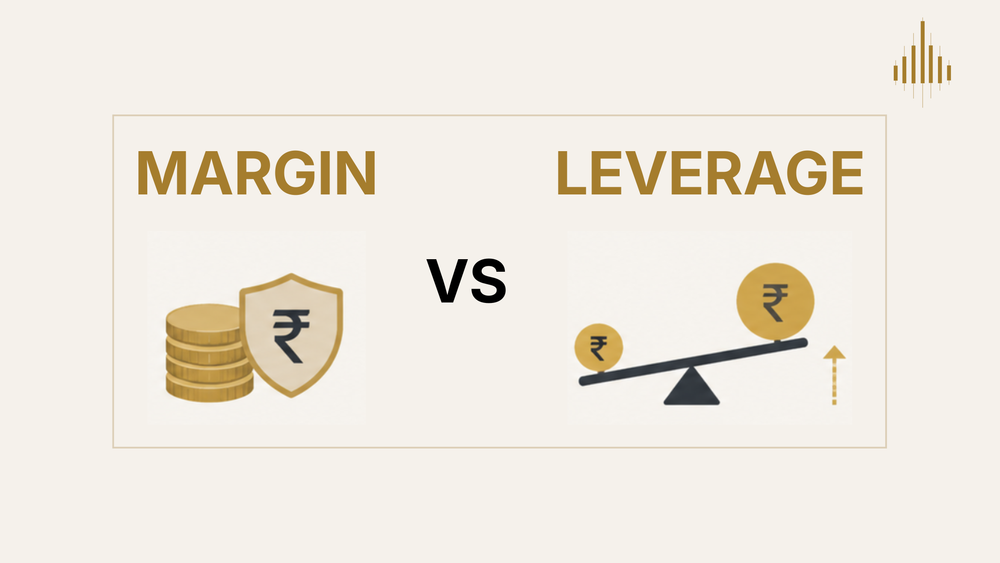
Ask ten traders to explain margin and leverage, and at least seven will explain the same thing twice. The words get used interchangeably everywhere - broker apps, YouTube, WhatsApp groups. They're related, but they are not the same thing. And if you're going to trade with either, you should know which is which. Consider this a beginner's guide to margin trading, minus the jargon.
For example, you want to buy a flat worth ₹1 crore. You have ₹20 lakh. The bank looks at your ₹20 lakh, funds the remaining ₹80 lakh, and the flat is yours. Your ₹20 lakh down payment - that's margin. The fact that you now control a ₹1 crore asset with ₹20 lakh of your own money, five times your capital, that's leverage.
Margin is what you put in. Leverage is how much bigger the deal is than your money.
Trading works the same way, just faster.
What is margin in trading?
Say you want to take a ₹1,00,000 position and your broker asks for 20% margin. You deposit ₹20,000; the broker covers the rest, and your ₹20,000 serves as collateral. That deposit is your margin, measured in rupees or as a percentage.
What is leverage in trading?
Leverage is the multiple that results from that arrangement. ₹1,00,000 position divided by ₹20,000 of your money i.e. 5x. You didn't choose the leverage separately; the margin requirement decided it. A 20% margin requirement always means 5x leverage. 10% would mean 10x. 50% would mean 2x. The lower the margin, the higher the leverage; they're two ends of the same seesaw.
So when someone asks what the difference is, the short answer is: margin is the input, leverage is the output. You deposit margin. You end up with leverage.
Why traders use leverage and what it costs
Now, why does anyone do this?
Because of the maths on the way up. Your ₹20,000 controls ₹1,00,000. If the stock rises 5%, the position makes ₹5,000, which is 25% on your money. Without leverage, the same move would have made you 5%. That gap is the entire sales pitch.
What the sales pitch skips is that the maths doesn't know which direction the stock is moving. The stock falls 5%, the position loses ₹5,000, and that's 25% of your capital gone. Same multiplier, opposite sign. Leverage doesn't improve your judgement or your odds. It just turns a 5% move into a 25% event, both ways.
The margin call: where leverage actually hurts
And there's a mechanical detail most explainers skip, which happens to be the part that actually hurts people: the margin call.
Your losses don't come from some abstract pool. They come out of your ₹20,000 deposit, in real time. If the position keeps moving against you and your deposit falls below the level the broker needs to remain protected, the broker will ask you to top up. If you don't or can't, because it's 11:40 am and you're in a meeting, they will square off your position themselves. At the market price.
Run the numbers and you'll see why leverage and survival time are connected. At 5x, a 20% move against you wipes out your entire deposit. At 10x, a 10% move does it. The higher the leverage, the smaller the move that finishes you. That's the trade-off nobody states plainly: more leverage, less room to be wrong.
SEBI leverage limits in India
One more thing worth knowing before you trade in India: you don't get to pick any leverage you want. SEBI sets the limits, and they vary by segment and broker. For intraday equity, peak-margin rules cap it at 5x.
Three things are worth remembering. Margin is what makes leverage possible. Leverage makes every outcome bigger — it has no opinion on which outcome. And a margin call isn't bad luck; it's the rulebook executing itself on whoever runs out of deposit first.
Margin is what you commit. Leverage is what you're exposed to. Don't confuse the two, and don't let anyone sell you the second while only mentioning the first.
Trading with leverage carries the risk of losses that may exceed your initial deposit. This is educational content, not investment advice.


