
How to use limit order as a market order?
How to use limit order as a market order? Find a clear answer in this FAQ by 021 Trade.
A trade may sometimes execute at a price different from what a trader expects. This usually happens when there are very few buy or sell orders available for a particular stock. Such situations are common in low-liquidity stocks or when a large market order is placed without sufficient matching quantity at nearby prices.
Placing a market order ensures quick execution, but it also carries the risk that the trade may be executed at an unfavourable price. On the other hand, a limit order gives the trader more control, as it will only execute at the specified price or a better one. However, the order may remain unexecuted if the market does not reach the set price.
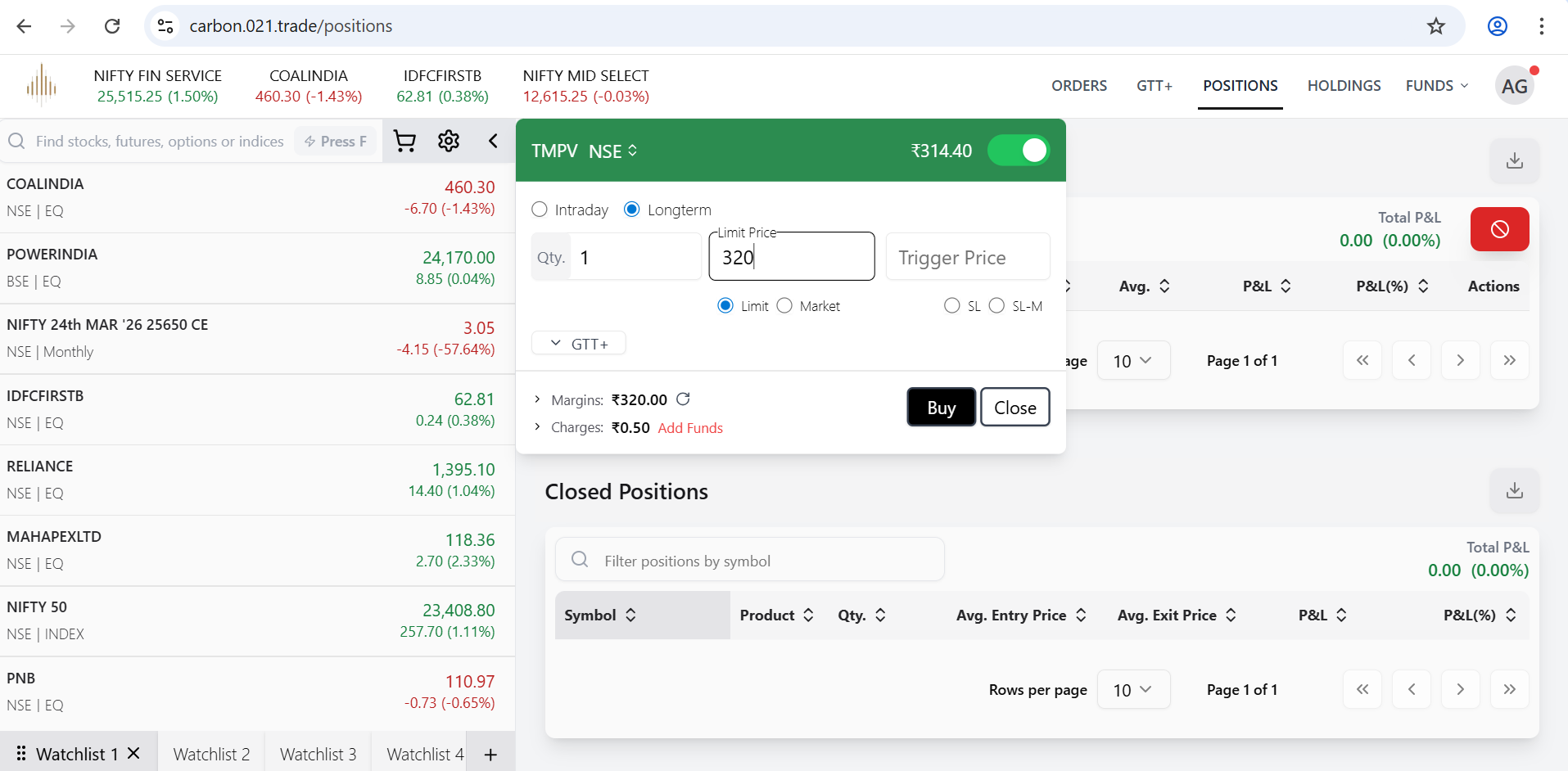
A limit order can also be used in a way that behaves similar to a market order while still providing price protection. This can be done by placing a buy limit order above the current market price or a sell limit order below the current market price. In such cases, the order has a higher chance of executing immediately while still maintaining a defined price limit.
Cash Segment Example
Assume the current market price of Tata Motors is ₹982. A buy limit order is placed at ₹990.
Since ₹990 is higher than the current market price of ₹982, the order behaves like a market order and executes immediately.
All available quantities up to ₹990 will be filled.
If a large market order pushes the price higher during execution, the ₹990 limit ensures that the buy price does not exceed ₹990, thereby protecting the trader from an unfavourable price spike.
Similarly, a sell limit order placed below the current market price can also act like a market order while still providing price protection.
F&O Segment Example
Assume a long position in HDFC Bank 1600 CE, currently trading at ₹47. A sell limit order is placed at ₹44, which is below the current market price.
Since the limit price is lower than the current price, the order executes immediately and sells the available quantity up to ₹44.
If sudden selling pressure occurs due to a large market order, the ₹44 limit ensures that the order will not execute below ₹44, thereby protecting the trader from a worse price fill.


