
A Real-World Guide to Buying Stocks in India

So, you’ve been hearing about the stock market lately, with everyone talking about “investing”, “returns”, and “long-term gains”. And somewhere in between, you probably thought, ‘Alright, maybe it’s time I try this too.
Good call. But if you’ve ever opened a trading app or seen a live market screen, it can feel like walking into a noisy bazaar where everyone’s shouting numbers. Don’t worry; every investor felt that way the first time. The truth is, buying stocks in India is not difficult. It just looks complicated because people use too much jargon. Let’s take that away.
We will keep it simple. We will go step by step, like setting up a phone for the first time.
Step 1: What You’re Actually Buying
When you buy a stock, you’re not gambling. You’re buying a slice of a real company, a small piece of ownership. That’s it.
If the company grows and makes money, your piece becomes more valuable. That’s why prices rise. If the business struggles, your piece might lose value. So when people say, “I invested in stocks,” what they reaqlly mean is, “I own tiny bits of companies I believe in.”
You’re basically becoming a co-owner, not a speculator throwing darts at a board.
Step 2: How People Make Money from Stocks
There are two simple ways to earn here:
- Price rise: You buy at ₹100, and one day it’s worth ₹130. That ₹30 is your profit if you sell.
- Dividends: Sometimes, companies share part of their profits with you. It’s like a thank-you for being a shareholder.
That’s pretty much the heart of it. There’s no secret formula or shortcut, just these two.
Step 3: The tools you need are a demat account and a trading account.
Here’s something most first-timers get stuck on. You can’t just go to an exchange and buy a stock directly. You need two digital accounts:
- Demat Account: It’s your electronic locker. All the shares you buy are stored here in digital form.
- Trading Account: This is your shopping cart; you use it to place buy and sell orders.
Usually, brokers or platforms give you both together when you sign up. It takes just a few minutes online with your PAN, Aadhaar, and bank details.
If you think of it like online shopping, the trading account is the app, and the Demat account is the delivery box where your purchase lands.
Step 4: Choosing a Broker That Doesn’t Drive You Crazy
A broker or trading platform connects you to the market, kind of like the delivery service that brings you the goods.
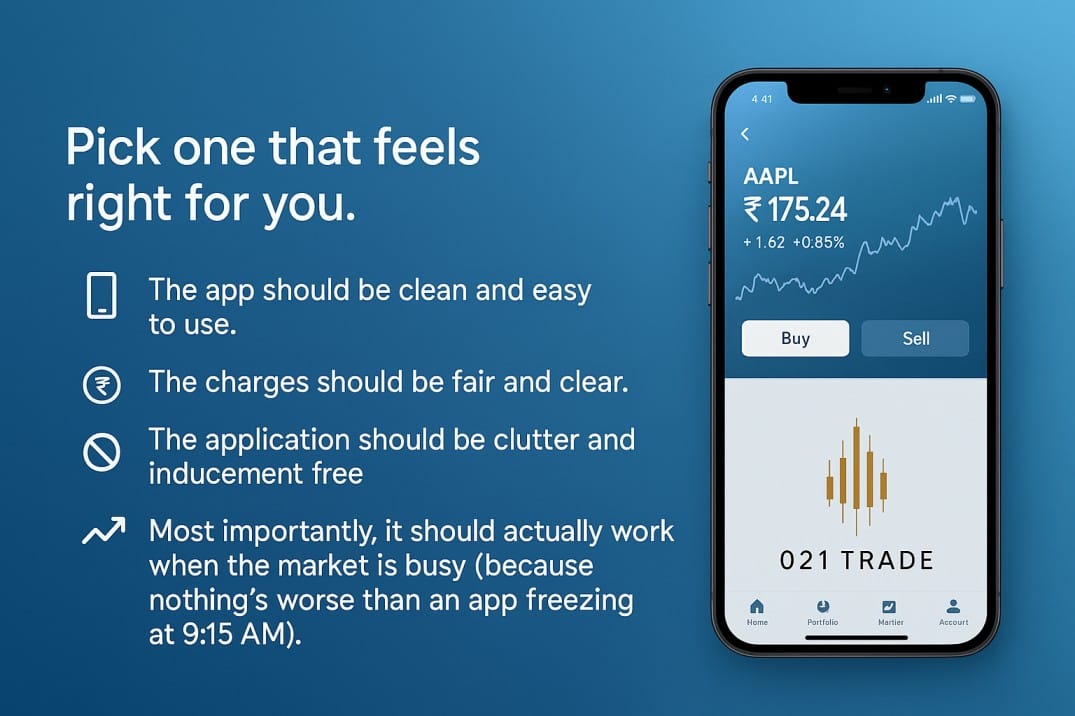
Step 5: Do the KYC and Setup
KYC (Know Your Customer) is basically the ID check. You’ll upload your PAN, Aadhaar, maybe a selfie or a short video for verification. It usually takes less than 20 minutes.
Once your account is active, link your bank account, and you’re ready.
Step 6: Add Some Funds
Before you can buy anything, you need to add money to your trading account. You can do this through UPI, internet banking, or a regular transfer. Start small. ₹500, ₹1,000 – it doesn’t matter. The idea is to learn the flow, not to chase profits on day one.
Step 7: Get Comfortable with the App
Spend a little time exploring. Create a watchlist: a list of companies you’re curious about. Look at how their prices move through the day. Click around the menus. See where the “Buy” and “Sell” buttons are, where your portfolio shows up, and what your order book looks like.
Don’t worry about pressing something wrong. You won’t break anything. This is your practice round.
Step 8: Understand Order Types (So You Don’t Panic Later)
When you buy, you’ll see different order options. Here’s the short explanation:
- Market Order: “Buy it right now, whatever the current price is.”
- Limit Order: “I’ll buy it only if it reaches my chosen price.”
Example: A share is at ₹100, but you only want it at ₹95. Place a limit order for ₹95. If the price drops to that level, it automatically buys for you.
That’s it – nothing mysterious.
Step 9: Don’t Buy Blindly
This is where most people mess up; they hear a “hot tip” from a friend or an influencer and hit buy.
Please don’t.
Spend five minutes reading about what the company actually does, how long it’s been around, and whether it’s making profits. You don’t need fancy analysis; just use common sense. If you wouldn’t lend money to a business like that, maybe don’t buy its stock either.
Step 10: Place Your First Order
Alright, moment of truth.
- Open the app.
- Search the company name.
- Click “Buy”.
- Enter how many shares you want.
- Pick a market or limit order.
- Confirm.
Done.
You just bought your first stock. The system will send you a confirmation, and within a few hours, it’ll appear in your Demat account.
Welcome to the club.
Step 11: No, Don’t Stare at It All Day
Seriously. Don’t check your portfolio every five minutes. The price will go up, then down, then up again; that’s normal. If you obsess over it, you’ll end up making emotional decisions.
Check maybe once a week. Let the market do its thing while you do yours. Investing is like cooking rice: keep lifting the lid, and it never cooks right.
Step 12: Think Long-Term, Not Lottery
If you came here for quick profits, you’ll burn out fast. The market rewards patience. People who stay invested for years usually end up happier (and wealthier) than those chasing daily spikes.
Small, consistent investments over time beat one-time big gambles. Every single time.
Step 13: Taxes – The Not-So-Fun Part
When you sell at a profit, the government takes a small cut that’s capital gains tax.
- If you sell within a year: short-term gain (taxed a bit higher).
- If you hold over a year: long-term gain (lower tax).
Keep records of your trades. Your broker usually gives you statements you can download.
Step 14: Mistakes Everyone Makes (and How to Dodge Them)
- Following crowd tips: Just because everyone’s buying doesn’t mean it’s right.
- Panic selling: Prices drop, and beginners freak out.
- Putting all money in one stock: That’s like putting all your food on one plate; one spill, dinner is gone.
- Expecting overnight riches: Markets don’t work like slot machines.
Make peace with mistakes. Everyone has a few. The trick is to learn fast and stay calm.
Step 15: Automate What You Can
Once you get the hang of it, set up small, regular investments weekly, monthly, or whatever fits your budget. It’s called rupee-cost averaging: you buy more when prices are low and less when they’re high. Over time, it smooths out the ups and downs.
It’s like drip-feeding your future wealth, quietly and consistently.
Step 16: Keep Learning, Always
The market changes. Policies shift, and industries rise and fall. Keep yourself updated.
You don’t have to study economics; just stay curious. Read a few financial blogs, maybe watch short educational clips. The more you understand, the calmer you become when everyone else is panicking.
Step 17: Celebrate Small Wins
Your first profit, your first dividend, and your first year as an investor – those are milestones. Take a moment to feel good about them.
Even if you started tiny, you did something most people never do: you took charge of your money.
Step 18: The Bigger Picture
Buying stocks isn’t about luck. It’s about believing that good businesses grow and letting time work for you.
You won’t get every call right, and that’s okay. No one does.
The secret is staying curious, staying patient, and staying invested.
You’ll thank yourself later.
Conclusion
Buying stocks in India has become very easy: open an account online, add funds, and buy. But understanding what you’re doing – that’s where the real magic is.
Start small. Learn slowly. Don’t rush.
The market isn’t going anywhere, but your financial journey starts the day you decide to.
So, take that first step today. One click, one stock, one tiny piece of ownership – that’s how every investor begins.
Disclaimer
The information provided in this article is for educational and informational purposes only and should not be considered as investment advice or a recommendation to buy or sell any financial instruments. Stock market investments are subject to market risks, and past performance does not guarantee future returns. While we strive to ensure the accuracy of information shared, 021 Trade makes no warranties or representations regarding its completeness or reliability. By using our platform or reading our content, you agree that 021 Trade is not liable for any loss or damage arising directly or indirectly from your investment actions.


